The networking world is often viewed as a battle of specs — bandwidth, latency, port density and power efficiency. But one of the more consequential stories of the past two decades had less to do with silicon and more to do with culture.
To understand why Arista Networks exists today, and how it grew into a company valued at over $100 billion, you have to rewind to the mid-2000s and step inside John Chambers’ Cisco. You have to understand this unique, highly lucrative, and ultimately controversial business model known as the “Spin-In”.
This is the story of the team behind Pensando (acquired by AMD in 2022), the rise of Jayshree Ullal, and how internal conflicts inadvertently funded the creation of Cisco’s fiercest competitor, Arista.
I worked at Cisco from the mid-2000s to early 2010s and witnessed some of these dynamics firsthand.
The “Spin-In” Innovation Machine
In the 2000s, Cisco CEO John Chambers had a problem. Cisco was becoming a behemoth, and as with many other big companies, it started moving slowly and losing its competitive edge. Chambers worried that top talent would leave to start their own companies, or that Cisco would miss the next big technology wave because of bureaucratic inertia.
His solution was the “Spin-In.”
Instead of forcing his best engineers to navigate HR and finance approvals to build a new product, Cisco would fund them to leave. They would form a “startup” just down the street. Cisco would own the rights to buy them back later at a pre-determined, massive valuation if they hit their milestones.
It was genius, but it created a two-tier system: the chosen few got startup equity and autonomy; everyone else got a salary and corporate red tape.
The “MPLS” Team
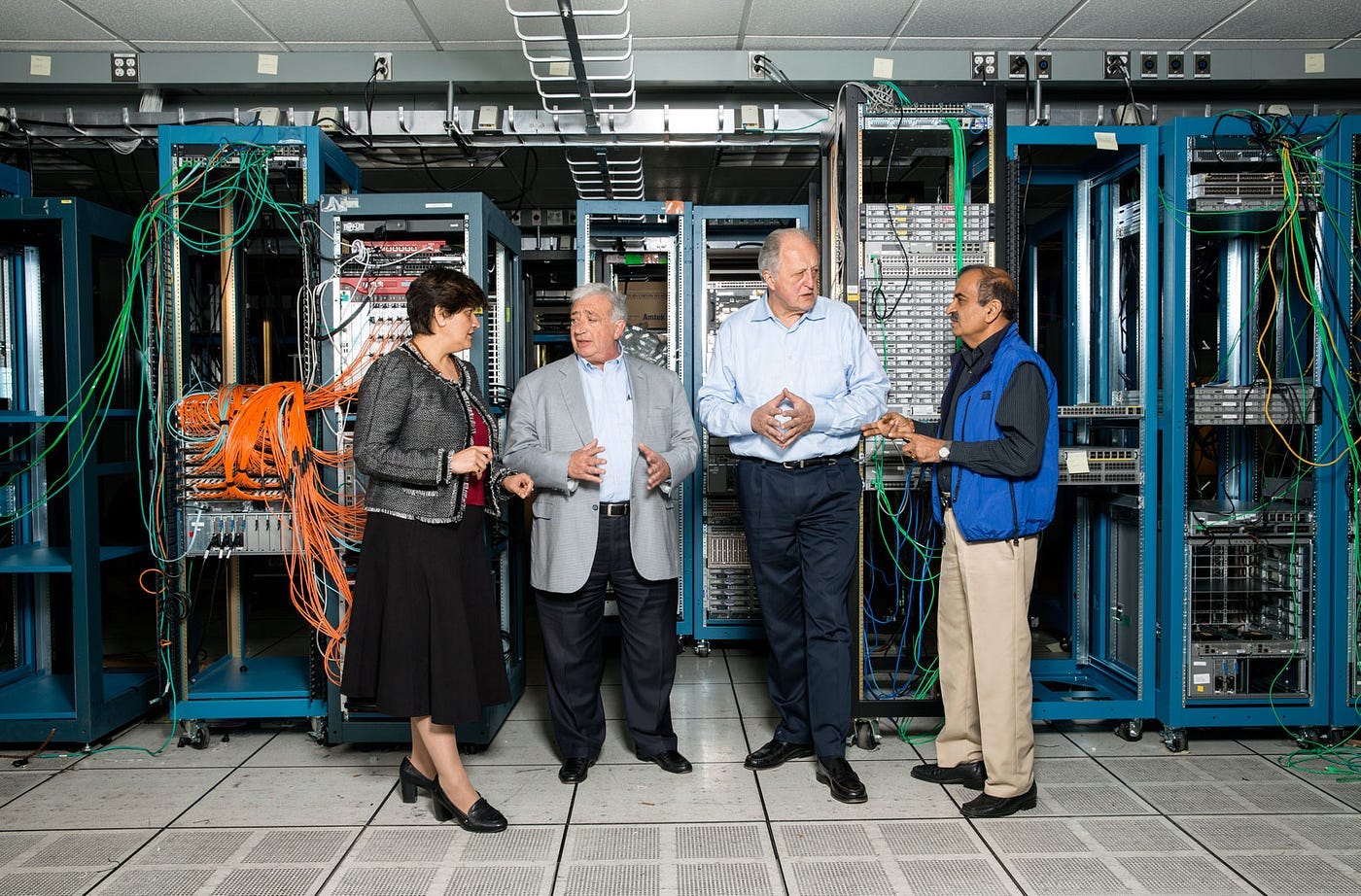
The primary beneficiaries of this model were a legendary quartet of executives. Inside Cisco, they were known by the moniker MPLS. It was a cheeky pun on the famous networking protocol (Multiprotocol Label Switching), but it stood for their first names:
This team had a Midas touch. Every few years, the MPLS team would “leave,” build the next big thing, and get bought back by Cisco for hundreds of millions. Of course, to their credit, the products developed by each of their companies went on to become important pieces in Cisco’s roadmap.
Crescendo (1993): Acquired for ~$95M. This became the Catalyst 5000/6000 series, arguably the most successful networking product in history.
Andiamo (2002): A storage spin-in acquired for ~$750M. This became the MDS 9000 (SAN switching).
Nuova Systems (2008): A data center spin-in acquired for ~$678M. This became the Nexus switch and the UCS server line.
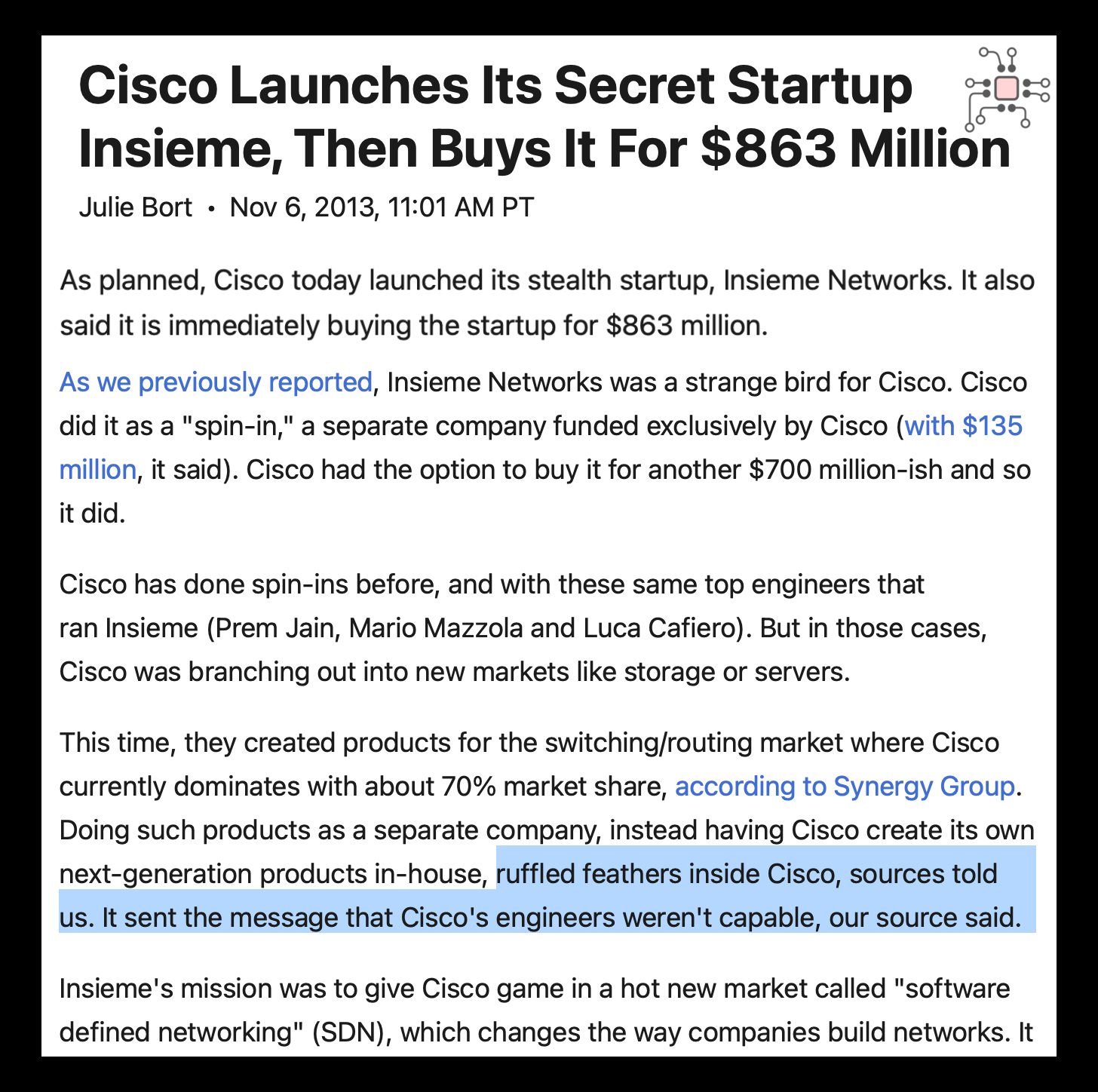
Insieme (2013): An SDN spin-in acquired for ~$863M. This became Cisco ACI (Application Centric Infrastructure).
News report from 2013 capturing the mood when Cisco acquired Insieme, the MPLS team’s third spin-in (Source: Business Insider)
The Collision Course
One of the key figures who had joined Cisco via the Crescendo acquisition in 1993 was Jayshree Ullal. She went onto become a seminal figure within Cisco, loved and admired by the majority of Cisco employees. By 2008, she was Senior VP of the Data Center, Switching, and Services Group. She was responsible for over $10 billion in revenue.
So, while the MPLS team was operating in their lucrative semi-private bubble, Jayshree Ullal was running the actual business within Cisco. She was the one executing, scaling, and managing the massive Catalyst portfolio that paid the bills.
The friction reached a breaking point with Nuova Systems.
Nuova (the MPLS team’s 2008 spin-in) was building the Nexus switch. This wasn’t just a complementary product; it was the future of the data center. It was designed to handle a unified fabric of Ethernet and storage.
The problem was that it directly cannibalized the Catalyst business Ullal was running.
Ullal found herself in an impossible position. She was managing the company’s biggest vertical, yet the future roadmap was being built by a “startup” team that operated outside her control. A team that was guaranteed a massive payout while her own team was bound by standard corporate compensation.
Realizing that the structure favored the “spin-in” inner circle over operational leadership, Ullal resigned in May 2008.
In 2008 Jayashree Ullal surprised many by leaving Cisco. Just months later she re-emerged as Arista’s new CEO (Source: Network World)
The Vindication: Arista Networks
Five months later, Ullal joined Arista Networks as CEO, teaming up with founders Andy Bechtolsheim and David Cheriton.
At Arista, Ullal didn’t just compete with Cisco; she exploited the weakness of the MPLS philosophy.
The MPLS team (and Cisco generally) believed in Custom ASICs. They believed that to get the best performance, you had to design your own chips. While custom chips offer differentiation and have legitimate advantages, they are proprietary and time consuming to produce.
Ullal and Arista took a different bet: Merchant Silicon. They believed that generic chips from Broadcom would eventually catch up to custom silicon in speed, but at a fraction of the cost. Arista focused their engineering power not on chips, but on software building a programmable, Linux-based stack that the hyperscalers (Google, Microsoft, Meta) were desperate for.
She was right.
While Cisco was busy integrating their expensive Nuova/Insieme acquisitions and fighting complexity, Arista’s “commodity chip + superior software” approach swept through the cloud market.
The piece recounts the bitter rivalry between Cisco and Jayshree Ullal. What started as respect between them, turned personal as Arista’s success eroded Cisco’s market share in switching — a business Jayashree Ullal once ran.
Cisco responded with internal “war room” efforts and legal battles, accusing Arista of copying its technology, while Arista characterized those tactics as defensiveness from a legacy company losing ground to a faster, more innovative competitor.
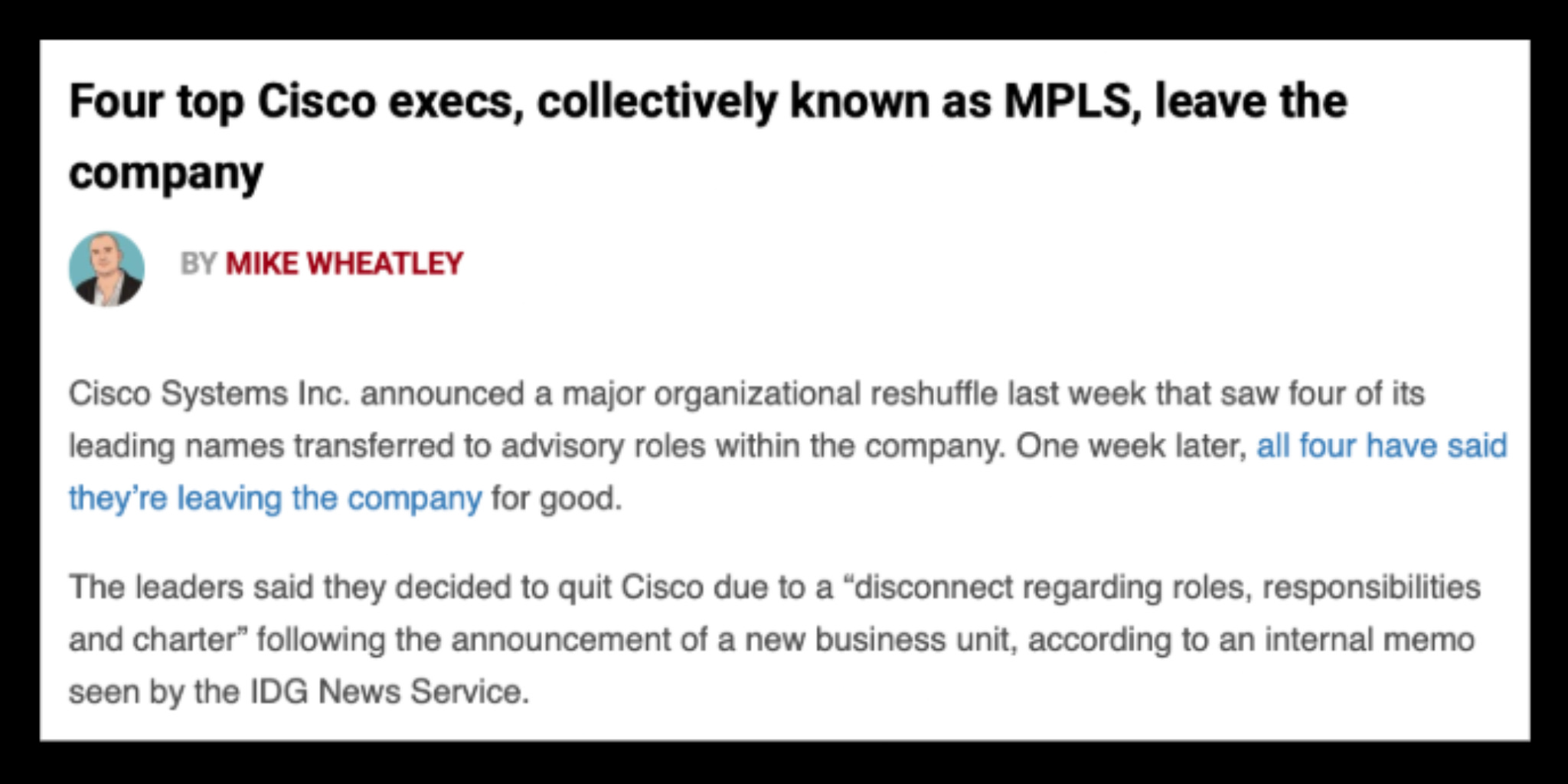
The spin-in era eventually ended. When Chuck Robbins took over as Cisco CEO in 2015, he dismantled the model, recognizing that it destroyed internal morale and siloed innovation.
News article dates June 6, 2016 [Source: Silicon Angle]
The MPLS team left Cisco one final time to found Pensando Systems (focused on DPUs/SmartNICs). Cisco did not buy them back this time. Instead, AMD acquired Pensando for $1.9 billion in 2022.
Meanwhile, Jayshree Ullal went on to build Arista into one of the most successful networking companies of the cloud era. Today she is widely regarded as one of Silicon Valley’s most effective CEOs. And at a net worth north of $5 billion, if you assumed the richest Indian-American CEO in the Valley was Satya Nadella or Sundar Pichai — you’d be mistaken.